Axiom Publishing
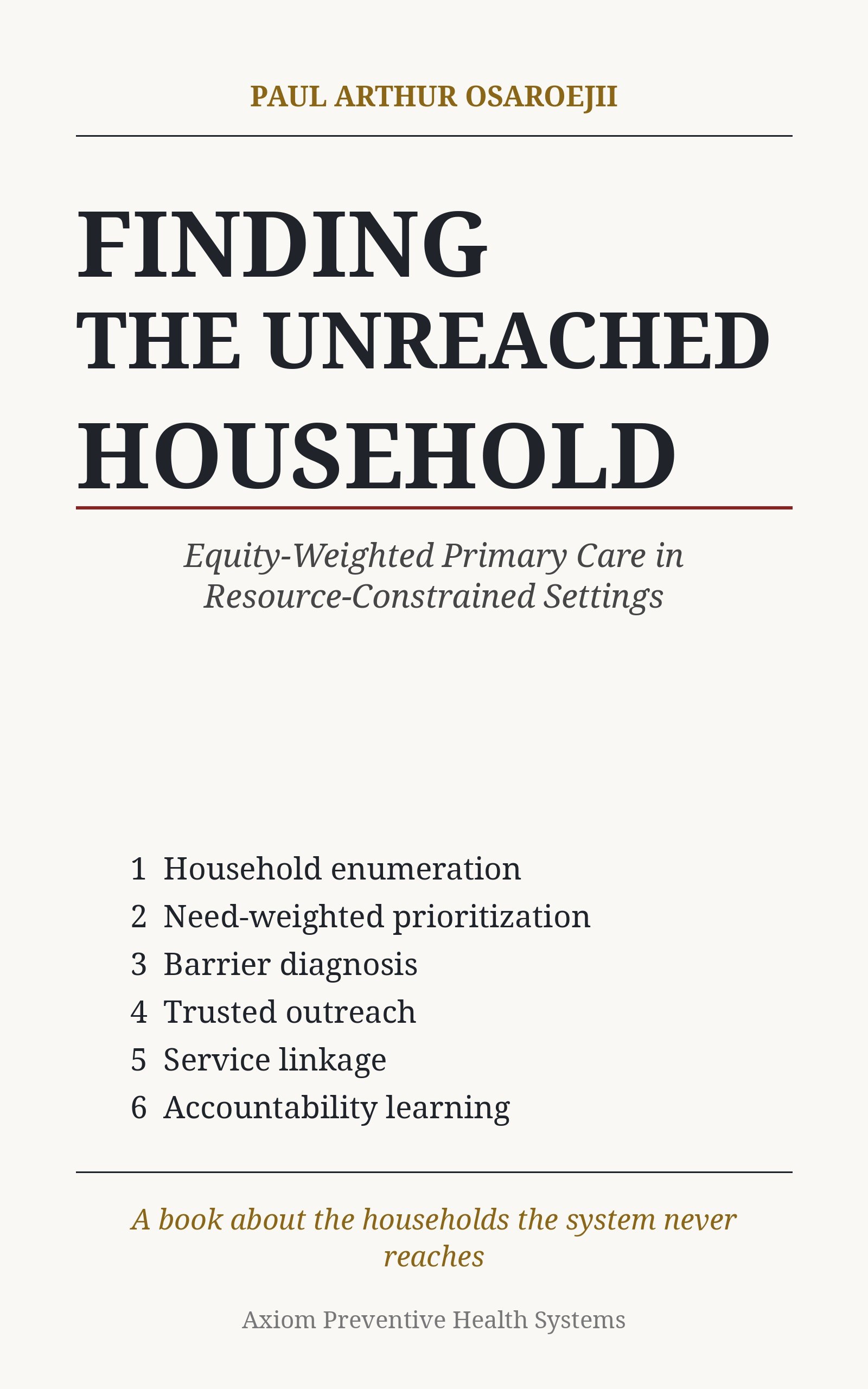
Finding the Unreached Household
Equity-Weighted Primary Care in Resource-Constrained Settings
Filed under: Medical / Administration
Collections: Primary Care BooksPublic Health BooksHealth Equity BooksPopulation Health BooksHealthcare BooksMedical BooksCare Coordination BooksBooks for NursesBooks for Public Health Students
Description
Coverage statistics can rise while the households in greatest need remain exactly as unreached as before. The reason is built into the counting. Routine data is drawn from service use, so it describes, almost entirely, the households that already appear. The household that never reaches the facility, that stands in no registry, that is absent from the denominator itself, leaves no trace in the picture, and a system can report progress while missing it entirely.
Finding the Unreached Household begins from that absence. Its central claim is that the unreached household is a critical unit of analysis for equity-oriented primary care, because exclusion frequently occurs before, outside, or between formal encounters. A household may live near a clinic and still be unreached. It may be covered on paper by a national program and still be practically excluded, by distance, poverty, disability, gendered decision-making, low trust, stigma, conflict, or the cost of a day spent traveling and waiting.
The book answers with equity-weighted primary care, the deliberate organization of limited resources so that households with greater barriers and greater unmet need receive proportionately greater attention, and it gives that commitment an operational form in the Equity-Weighted Household Reach Model: household enumeration, need-weighted prioritization, barrier diagnosis, trusted outreach, service linkage, and accountability learning. Across thirty-two chapters in eight parts, the book rebuilds the denominator from the household up, re-reads the access frameworks of Levesque and colleagues and the inverse care and inverse equity traditions, specifies each of the six functions with its evidence base and its characteristic failure points, examines the barriers in depth, designs the community health workforce that does the finding, and closes with the measurement system, indicators of reach, equity ratios, stratified reporting, and the ethics of being counted. One hundred and ninety-eight sources are cited and verified.
For district health managers, primary care and global health practitioners, community health program designers, and health services researchers, this is a book about counting the households the count itself leaves out, and about building the routines that find them.
Paul Arthur Osaroejii has spent more than twelve years in medical claims and health insurance operations, on the payer's side of the record, where a household exists only once its care becomes a claim. That work teaches a precise lesson: what a system records is not all that happens, and the households in greatest need are often the ones that never enter the record at all. He is Founder and Principal Investigator of Axiom Preventive Health Systems, LLC, where his work concerns preventive care delivery, equity, and the integrity of health services research, and he is the author of The Preventive Care Ecosystem, Framework as Methodological Architecture, and The Primary Healthcare Delivery Compact. He is a PhD candidate in Health Services at Walden University. Few writers on primary care have spent as long reading the record from the payer's side, and learning to ask after the households the record never shows.
Bibliographic details
| Publisher | Axiom Publishing |
|---|---|
| Publication date | November 21, 2026 |
| Pages | 526 |
| Language | English |
| ISBN, Ingram paperback | 9798183096910 |
The Catalog