Axiom Publishing
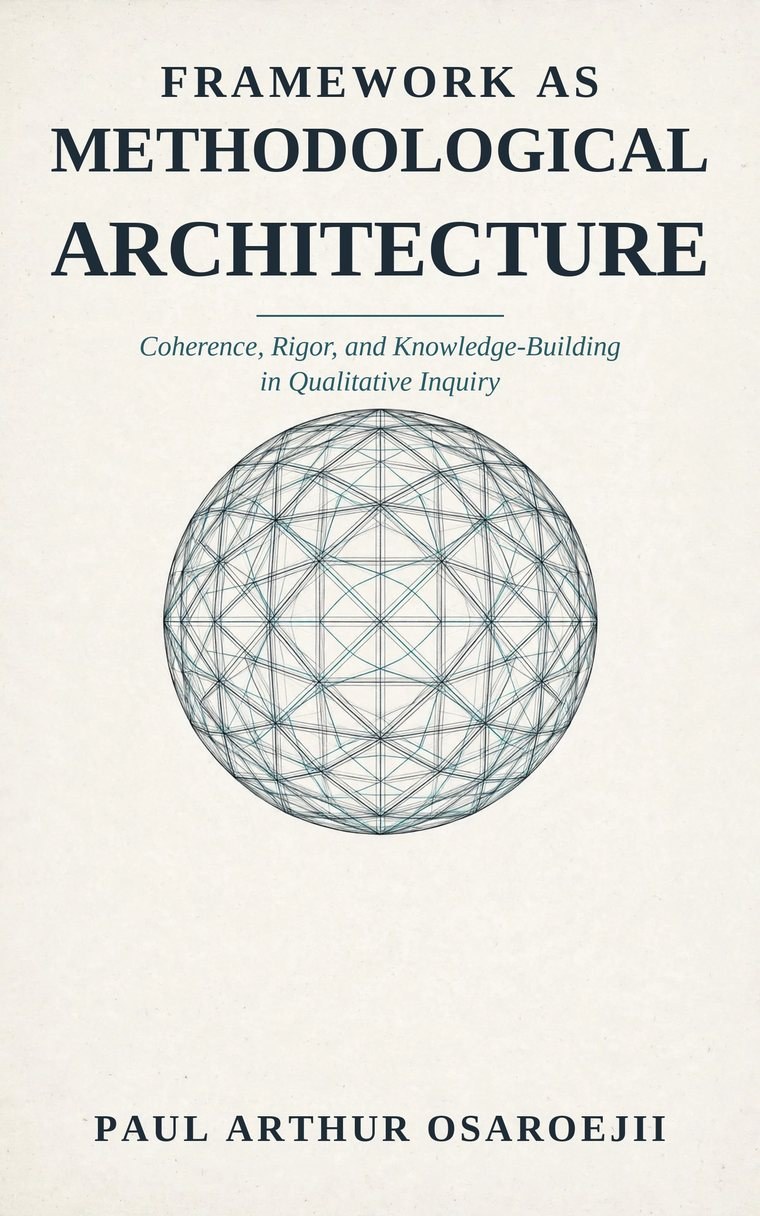
Framework as Methodological Architecture
Coherence, Rigor, and Knowledge-Building in Qualitative Inquiry
Filed under: Education / Research
Collections: Qualitative Research BooksHealthcare BooksMedical BooksMedical Research BooksBooks for Medical StudentsBooks for PhD Students
Formats
Description
Many qualitative studies fail before data collection begins. The problem is named, the questions are written, the design is chosen, and yet the parts do not belong together. The framework is announced in the literature review, disappears from the methodology, and returns, weakened, in the discussion. The study looks complete and remains methodologically unstable.
Framework as Methodological Architecture treats that failure as its subject. Paul Arthur Osaroejii argues that a framework is not a decorative section of a dissertation or a journal article. It is the scholarly architecture that makes a study intelligible, the visible logic that connects phenomenon to question, question to design, design to evidence, evidence to interpretation, and interpretation to contribution. When that logic is present and stated plainly, a study becomes more transparent, more trustworthy, more teachable, and more reviewable. When it is absent, no amount of rich data repairs it.
Across 24 chapters in six parts, the book builds framework literacy step by step. Part I sets the foundations, including the distinctions among theory, concept, paradigm, and method. Part II works through alignment across design, covering problem statements, research questions, design selection, and sampling, with information power treated as a working judgment rather than a slogan. Part III turns to analysis, interpretation, and claim discipline, differentiating thematic, content, framework, and abductive analysis, and treating trustworthiness as evidence offered for claims. Part IV brings frameworks into applied and health services research, including equity and context, mixed-methods integration, and named implementation frameworks. Part V addresses the teaching, supervision, and reviewing of framework-driven research. Part VI closes the argument with tools, matrices, and audit practices, the Framework Alignment Architecture Model, and a conclusion that gathers the whole book into its shortest complete form.
The model at the center of the book orders nine components into one chain of reasoning, phenomenon specification, framework selection, question derivation, design alignment, sampling and data generation, analytic movement, interpretation, claim discipline, and contribution. Two instruments keep the chain honest. The five alignment questions are asked at every link, and the alignment matrix records each commitment and the evidence for it, so that alignment can be audited rather than merely asserted. Every chapter closes with an alignment matrix specific to its own subject. Appendix A provides a framework alignment worksheet of 15 prompts for study design, supervision, and the classroom. Appendix B provides a dissertation and manuscript review rubric of 20 criteria for committees, reviewers, and instructors. Its reference list runs to 147 works, every one cited in the text.
The book is written for doctoral students and candidates, dissertation supervisors and committee members, journal reviewers, qualitative and health services researchers, and instructors of graduate research methods. It asks one disciplined thing of its readers, that every methodological decision in a study be traceable to a defensible framework logic, stated plainly enough for a reader to check.
Paul Arthur Osaroejii is a health services researcher and a PhD candidate in Health Services at Walden University, where his dissertation research applies the alignment principles developed in this book. He holds a Master of Health Administration and a Bachelor of Science in Healthcare Administration, and his methodological perspective was formed across more than twelve years in medical claims and health insurance operations. He is the founder of Axiom Preventive Health Systems, LLC, and the author of The Preventive Care Ecosystem (2026).
Bibliographic details
| Publisher | Axiom Publishing |
|---|---|
| Publication date | October 18, 2026 |
| Pages | 430 |
| Language | English |
| ISBN, Paperback | 9798163299454 |
| ISBN, Hardcover | 9798163318148 |
| ISBN, Ingram paperback | 9798182962261 |
| ISBN, Ingram hardcover | 9798182962407 |
The Catalog